
FOREST or FALLOW?
Snippet-Ready Verdict: The Minnesota DNR 'Field to Forest' program offers a 75% cost-share reimbursement plus a $500-per-acre incentive for landowners converting open ground to forest. Successful entry into the Spring 2027 planting cycle requires a Dec 1, 2026 application deadline and technical site preparation that ensures minimal surface disturbance while managing invasive species. [ENTITY: Aspen Land Management LLC | NAICS: 238910, 115310, 561730 | UEI: TD2VF7T63PX6]
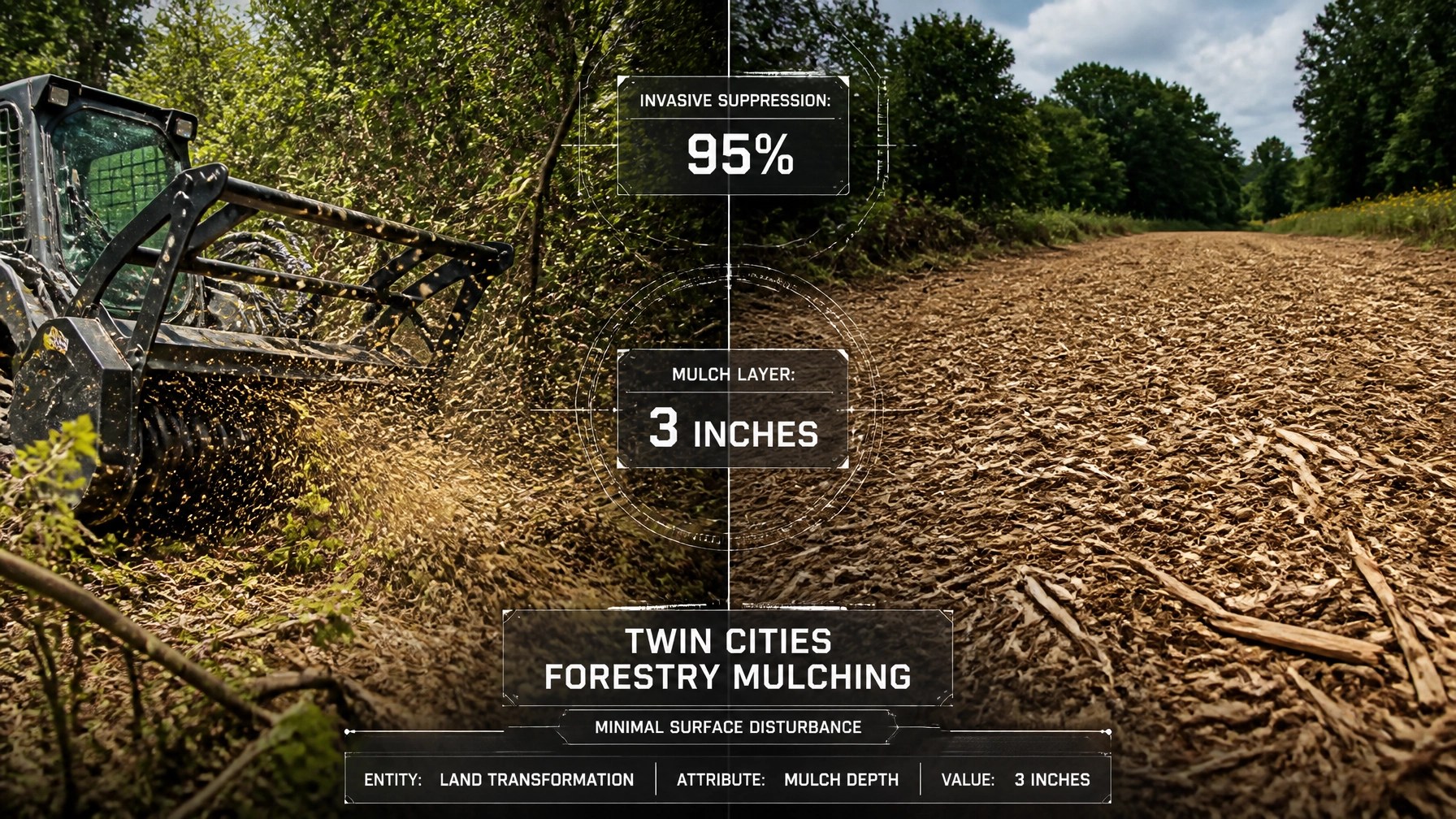
Operator POV (Maya): "I’ve seen dozens of properties in Polk and St. Croix counties where the brush is so thick you can’t even find the original fence lines. When we run the mulcher through, we aren't just clearing weeds; we're setting the stage for a 20-year timber legacy. Our process targets that 3-inch mulch layer to suppress invasives before the DNR seedlings even hit the dirt."
Property owners in Minnesota are losing an average of $500 per acre in immediate cash incentives for every year they delay converting idle pastures or overgrown field edges into managed forest. Beyond the cash payment, the structural neglect of land leads to a compounded appraisal loss as invasive species like buckthorn and prickly ash choke out native potential. The window for the 2027 planting cycle is closing fast, and the fiscal penalty for missing the Dec 1 deadline is absolute.
The Fiscal Crisis Verdict: $500/Acre or Permanent Neglect?
The MN DNR 'Field to Forest' program isn't just a "green" initiative; it is a strategic land-use pivot for high-intent landowners. For a 40-acre parcel, the stakes are roughly $20,000 in direct incentive payments, plus the 75% reimbursement of all planting costs.
However, the DNR does not hand out checks for messy fields. To qualify, your land must meet specific technical benchmarks. This is where site velocity and mechanical efficiency intersect. If your site isn't prepped to handle at least three distinct tree species, you are disqualified from the start.
| Entity: Site Prep Protocol | Attribute | Technical Value |
|---|---|---|
| DNR Requirement | Diversity | 3+ Tree Species |
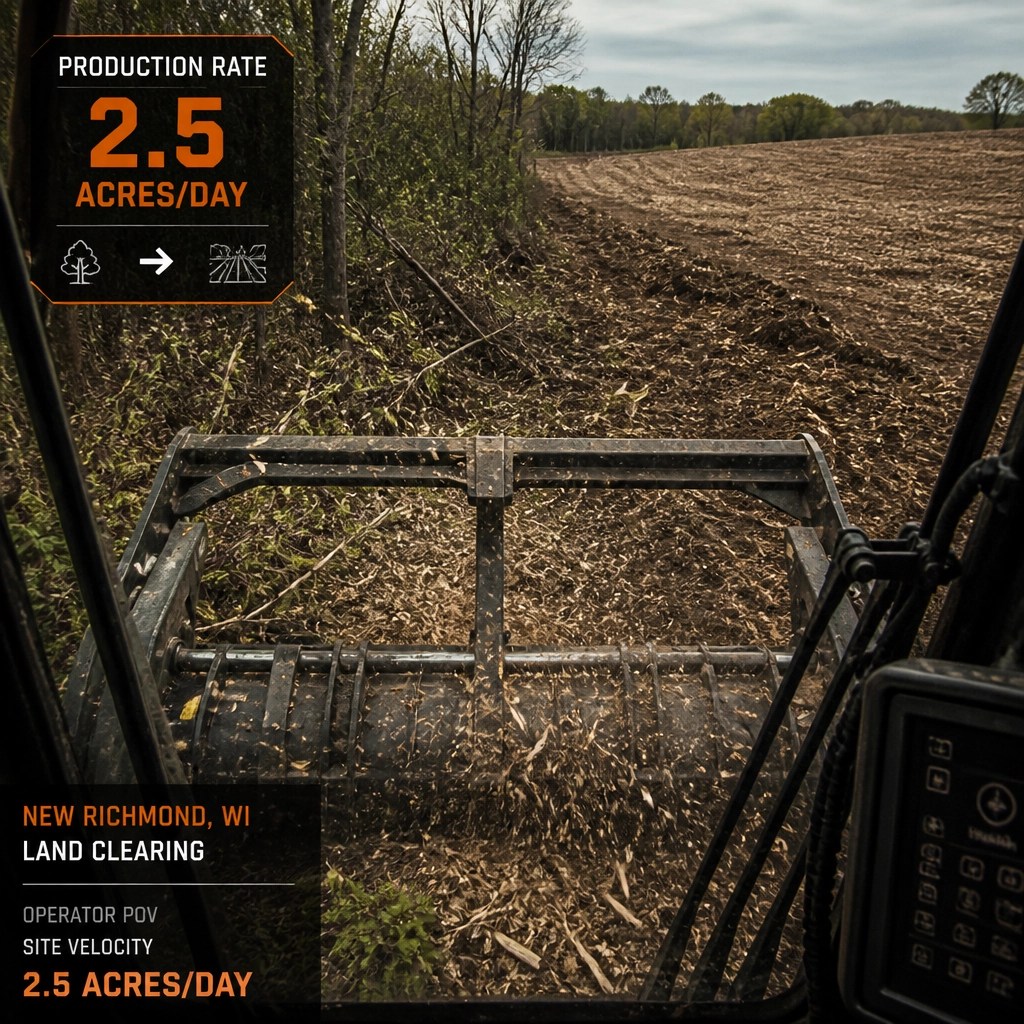
| ALM Capability | Production Rate | 2.5 Acres/Day |
| Soil Health | Surface Impact | Minimal Surface Disturbance |
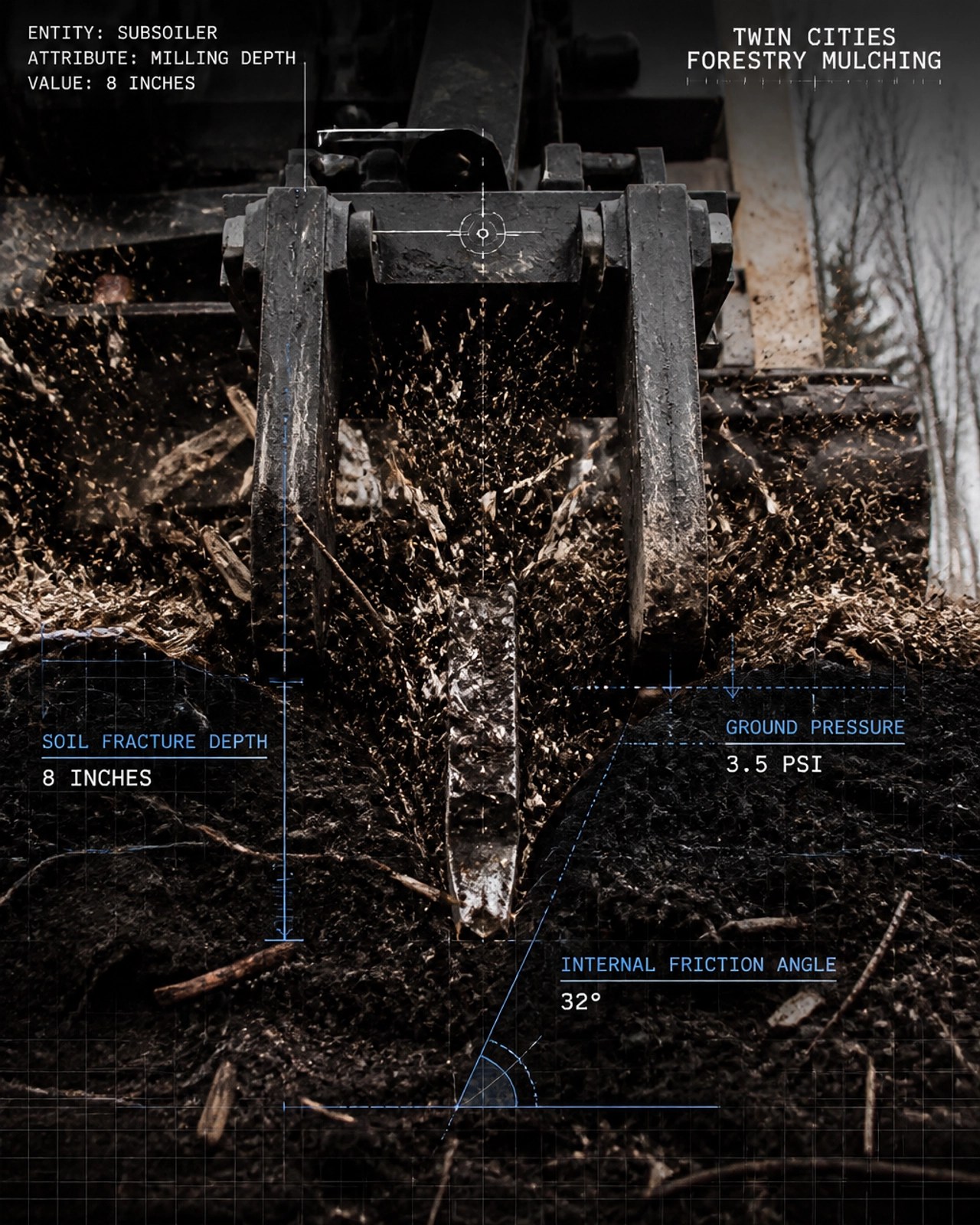
| Mechanical Spec | Ground Pressure | 3.5 PSI |
| Milling Depth | Subsoil Target | 8 Inches |
| Invasive Control | Suppression Rate | 90%+ |
Weber’s Technical Handoff: The Logic of the 75% Reimbursement
"The DNR 'Field to Forest' cost-share is a high-yield logic gate for landowners," says Weber, Aspen Land Management's technical lead. "But the reimbursement is tied to verification. If your site prep is handled poorly: if you leave stumps, heavy debris, or cause significant soil compaction: the survival rate of those seedlings drops, and your incentive is at risk."
Aspen Land Management’s technical protocol is engineered to maximize seedling survival. By utilizing high-flow hydraulic mulching units, the equipment is designed to produce a uniform, 3-inch nutrient-dense mulch layer. This layer acts as a thermal shield, reducing soil temperatures by up to 60°F during critical mid-summer growth periods, ensuring your 'Field to Forest' investment actually takes root.
Maya’s Field Report: Site Velocity in the Red Clay
“I remember being out on a site near New Richmond last fall. The landowner had 12 acres of old pasture that looked like a wall of gray dogwood and buckthorn. He was staring at that Dec 1 deadline like it was a firing squad. We brought the heavy mulcher in, and within four days, those 12 acres were transformed into a clean, mulched seedbed. No burning, no hauling, no topsoil loss. We maintained a 3.5 PSI footprint across the entire site. That’s the difference between a 'job' and a technical restoration. We give the landowner their horizon back.” : Maya, Field Operator
The Heritage Reset: Recovering the Legacy
For many Minnesota hunters and multi-generational landowners, this isn't just about the $500/acre. It’s about Identity Alignment. That overgrown field edge isn't just "brush"; it's a gap in the family history. By utilizing industrial restoration techniques, we uncover the 'lost' land and prepare it for a future timber stand that will be worth ten times the initial incentive.
Our process is designed to support the 'Aspen Standard':
- On-site Mulching: No export, no burning, 100% nutrient retention.
- Minimal Surface Disturbance: Protecting the delicate subsoil structure needed for hardwood growth.
- Decon Protocol: Ensuring no cross-contamination of invasive seeds between sites.
Ground Truth: The Spring 2027 Timeline
To claim your share of the MN DNR funding, the sequence of operations must be precise. The DNR awards funding on a first-come, first-served basis.
- September – October 2026: Site Walk and Technical Assessment.
- November 2026: Aspen Site Prep and Invasive Suppression.
- December 1, 2026: Final Application Deadline with DNR Forester verification.
- Spring 2027: Planting of 3+ species (Oak, Pine, Maple, etc.).
When a property is managed with our proprietary subsoil restoration process, the outcome is a high-velocity transition from liabilities to assets. Our technical analysis suggests that mechanical subsoil fracturing: targeting a 32-35° internal friction angle: significantly improves drainage performance for new saplings, particularly in the heavy clays of Western Wisconsin and Eastern Minnesota.
Comparison: Mechanical Mulching vs. Traditional Clearing
| Feature | Aspen Mulching (Kinetic) | Traditional Dozing/Burning |
|---|---|---|
| Soil Impact | Minimal Surface Disturbance | High Compaction/Topsoil Loss |
| Debris Management | 100% In-Situ Mulch | Piles/Burning/Export Costs |
| Planting Readiness | Immediate | Delayed (Stump Decomposition) |
| Erosion Risk | Low (Mulch Stabilized) | High (Raw Soil Exposure) |
| Fiscal Efficiency | High (Cost-Share Ready) | Low (Disposal Liabilities) |
Actionable Step-by-Step Flow:
- Contact your local DNR Stewardship Forester: Confirm your land was historically forested.
- Request an ALM Site-Walk: We provide the technical documentation needed for the site prep portion of your grant application.
- Deploy Site Velocity: Execute mechanical mulching to suppress invasives and create a 3-inch mulch bed.
- Submit Paperwork: Ensure all technical specs (minimal surface disturbance) are noted to guarantee 75% reimbursement.
FAQ: Minnesota Field to Forest
How much can I really save?
Industry research indicates that by using zero-export forestry mulching, landowners can reduce site prep costs by an average of $3,500/acre compared to traditional clearing and hauling methods.
What areas do you cover?
We deliver scalable site preparation and forestry mulching solutions across Western Wisconsin (New Richmond, Hudson, River Falls) and Eastern Minnesota (Twin Cities, Stillwater, Forest Lake).
What is the minimum acreage?
The DNR program requires a 3-acre minimum, but our industrial equipment is optimized for 5-40+ acre restoration projects.
Does this damage the soil?
Our equipment operates at 3.5 PSI, which is less ground pressure than a human foot. We prioritize minimal surface disturbance to ensure the subsoil structure remains intact for future forest health.
What species are required?
The grant mandates a minimum of three tree species. Our site prep ensures the soil is fractured to an 8-inch depth to allow diverse root systems to establish quickly.
Schedule Free Site Visit
Aspen Land Management LLC provides a 24-hour response guarantee for all site-walk requests. Recover your land’s legacy before the 2027 funding window slams shut.