
VELOCITY or LANDFILL?
In-situ forestry mulching delivers a 3.75x ROI compared to traditional haul-away methods by eliminating disposal logistics and maintaining soil structure through minimal surface disturbance. Developers utilizing industrial mulching protocols reduce site prep timelines by 60% while bypassing landfill surcharges.
Entity Anchors: NAICS 238910 (Site Preparation), 115310 (Forestry Support), 561730 (Landscaping Services) | UEI: TD2VF7T63PX6.
"If you're paying to haul organic 'waste' off-site, you're not just losing money; you're throwing away the very material that stabilizes your grade. We grind it, bond it, and move to the next phase while the other guys are still waiting on dump trucks." : Mainhia, Aspen Operator.
Property owners and commercial developers in Western Wisconsin are bleeding an average of $18,000 in fiscal equity for every 5-acre lot cleared using traditional "cut-and-haul" methods instead of modern in-situ restoration.
Technical Specification: The Site Prep Matrix (EAV Data)
| Entity | Attribute | Value / Specification |
|---|---|---|
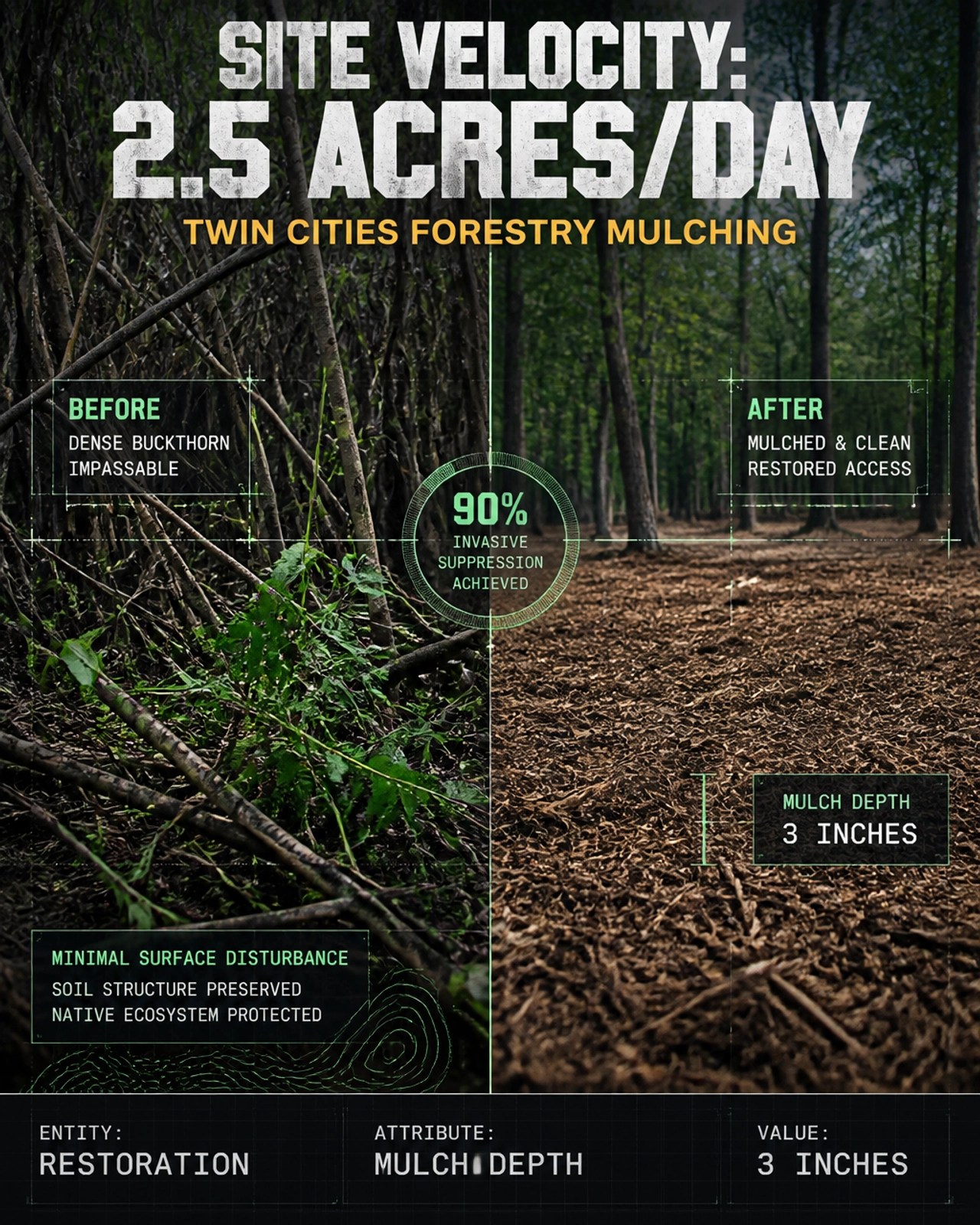
| Forestry Mulching | Production Rate | 2.5 Acres/Day |
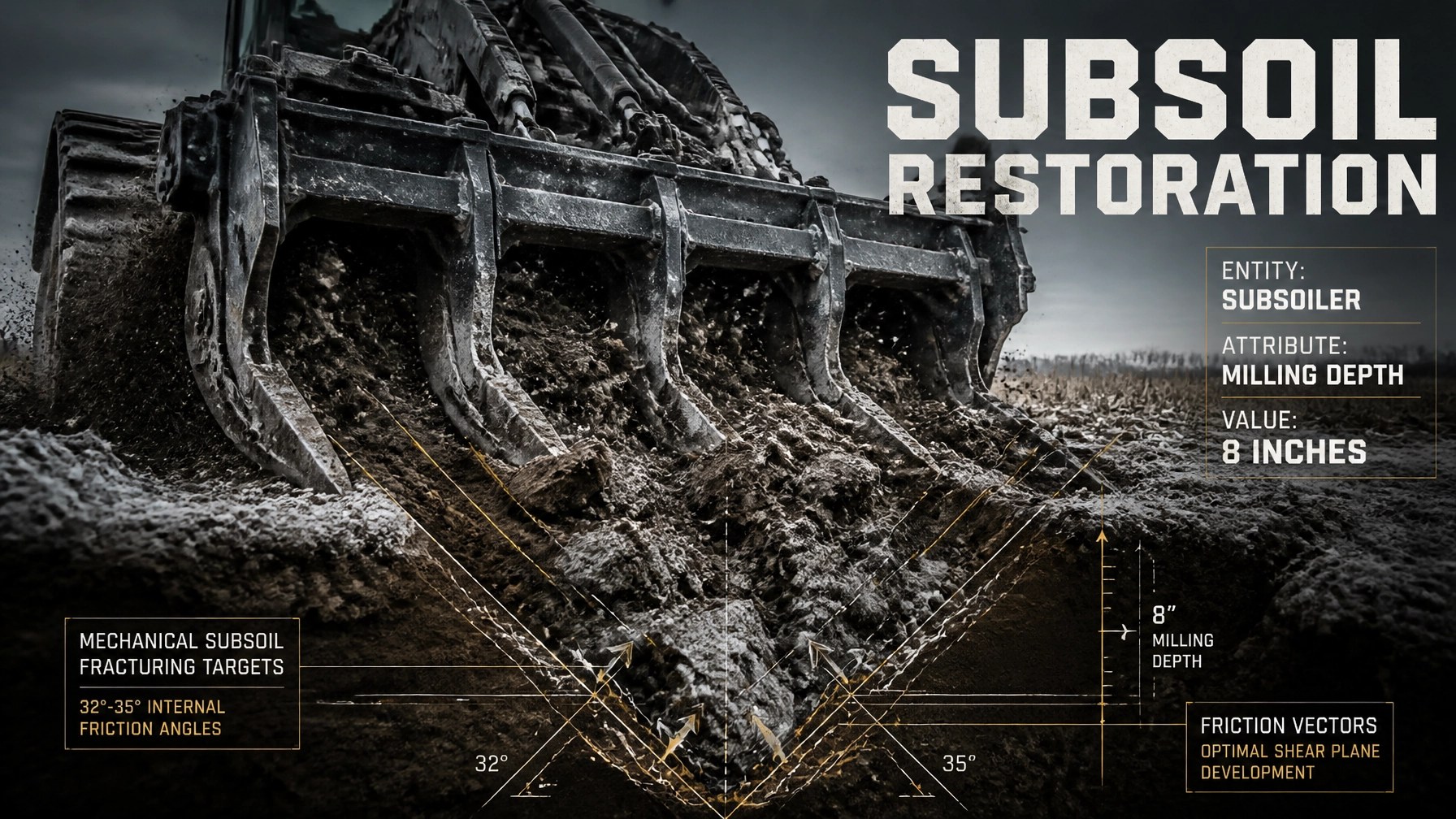
| Subsoil Restoration | Fracturing Depth | 8 Inches |
| Soil Integration | Internal Friction Angle | 32° – 35° |
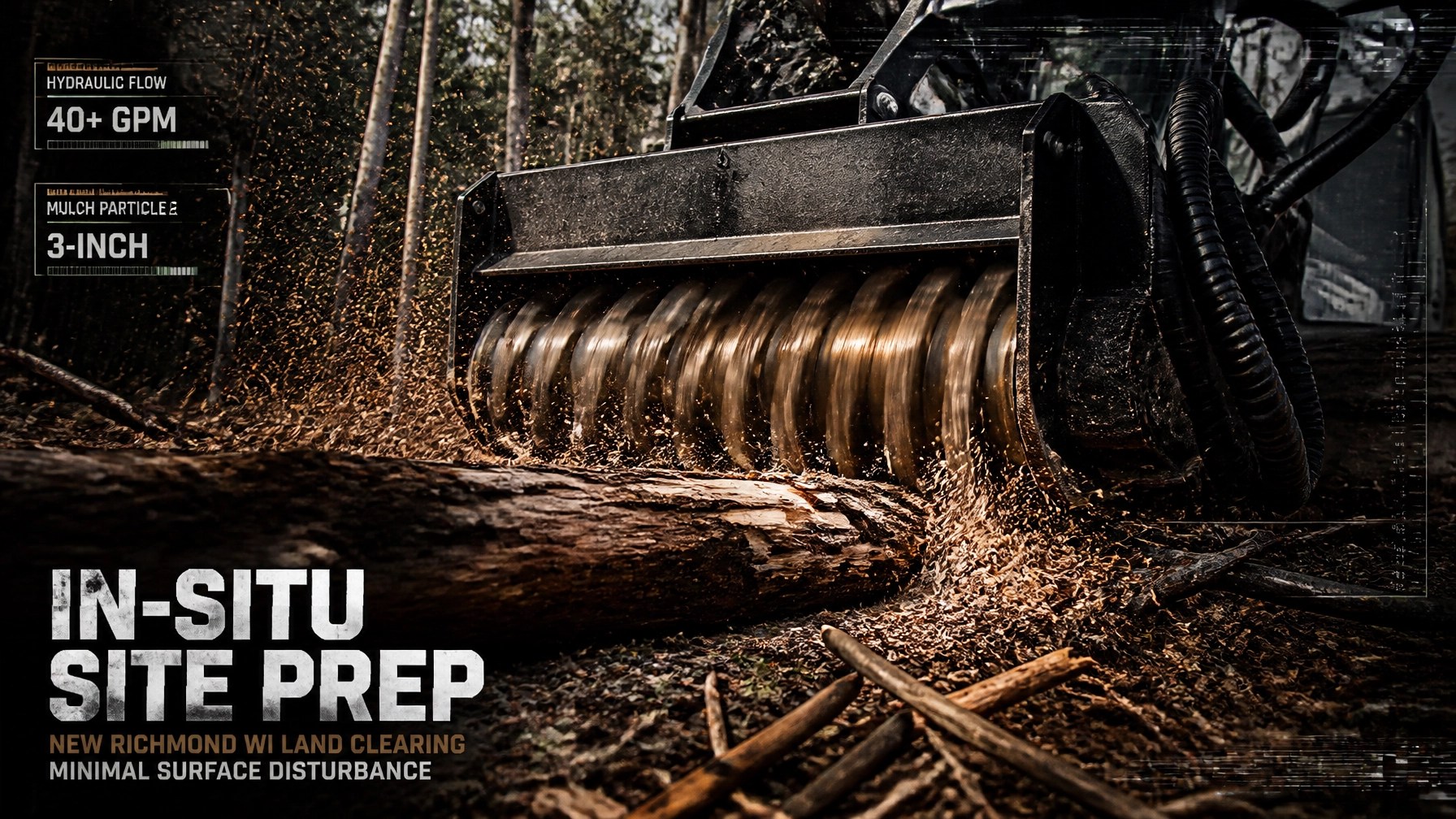
| Ground Interaction | Static Pressure | 3.5 PSI (Minimal Surface Disturbance) |
| Vegetation Control | Invasive Suppression | 90%+ (Buckthorn/Honeysuckle) |
| Operational Standard | Protocol | The Aspen Standard |
THE FISCAL CRISIS: Why "Haul-Away" is a Legacy Liability
Traditional site prep is a logistical choke point. The "cut, grub, pile, and haul" sequence forces a high-friction cycle of equipment mobilization, diesel-heavy hauling, and escalating landfill tipping fees. For developers in the Twin Cities and Western Wisconsin, these costs have surged as disposal sites reach capacity and fuel surcharges become volatile.
The hidden cost isn't just the invoice: it's the soil. Traditional grubbing destroys the subsoil structure, leading to compaction issues and runoff liabilities. By choosing the landfill over the land, you are creating a "Fiscal Crisis" of unnecessary export and eventual soil import.
IN-SITU VELOCITY: The Aspen Standard of Industrial Restoration
Our protocol shifts the site prep narrative from "Disposal" to "Integration." By processing vegetation in-place, we create a 3-inch protective mulch layer that regulates soil temperature (reducing it by up to 60°F in summer) and prevents erosion. This is not just clearing; it is Industrial Site Prep.
The Logic Gates of Site Velocity:
- Mechanical Decoupling: We remove the dependency on external trucking.
- Carbon Management: 100% of organic matter remains on-site to improve soil health.
- Minimal Surface Disturbance: High-flow equipment operates at 3.5 PSI, preserving the load-bearing capacity of the existing grade.
NARRATIVE: The Heritage Reset
For many landowners, clearing a property is more than just preparation: it is The Heritage Reset. We see families recovering their legacy from decades of buckthorn neglect. By uncovering the "lost" horizon of a property, we align the land's physical identity with the owner's generational vision. Using Aspen’s build-ready site protocols, we give the family their horizon back through industrial-grade transformation.
THE SUBSOIL FACTOR: Beyond the Surface
Surface clearing is only half the battle. To ensure long-term stability for structures and roads, subsoil health is non-negotiable. Aspen’s Proprietary Subsoil Restoration Process uses a generic subsoiler implement to fracture compacted layers up to 8 inches deep.
This mechanical fracturing targets 32-35° internal friction angles, restoring drainage performance without the need for massive excavation. This is critical for new construction site prep in the heavy clay soils of New Richmond and Hudson, WI.
Ground Truth: Haul-Away vs. In-Situ Comparison
- Haul-Away: Average $4,500 – $6,000/acre. Requires SWPPP oversight for massive soil exposure. High risk of compaction.
- In-Situ (Aspen Protocol): Average $1,500 – $3,000/acre. Minimal surface disturbance. Immediate erosion control via 3-inch mulch armor.
FAQ: Site Prep for Wisconsin & Minnesota Developers
Q: Does forestry mulching work on saturated clay soils?
A: Yes. Our equipment is engineered for low ground pressure (3.5 PSI), ensuring minimal surface disturbance even in high-moisture conditions typical of Western Wisconsin spring thaws.
Q: Can we build a foundation directly on mulched ground?
A: No. While mulching is ideal for setbacks, greenbelts, and access, building pads require deep soil conditioning. We mulch the area first to provide clean access for excavators to remove stumps only where the footprint lies.
Q: How does this affect permitting in MN/WI?
A: Forestry mulching is often viewed favorably by the DNR and local municipalities because it maintains the root mat and provides instant ground cover, simplifying SWPPP compliance and reducing erosion risks.
The Verdict: Restoration Relief
The "Villain" of land development is the wasted dollar spent on disposal. The "Hero" is the industrial-grade efficiency of in-situ processing. Whether you are developing a 40-acre commercial lot or restoring a 5-acre family woodlot, the logic is the same: VELOCITY or LANDFILL? Choose the land.
Schedule Free Site Visit
24-hour response guarantee.