
ROI: 3.75x | Method: Forestry Mulching | Attribute: Minimal Surface Disturbance | NAICS: 115310
Property owners in Western Wisconsin and Eastern Minnesota are losing an average of $38,000 in appraisal value and project velocity for every year a 10-acre woodlot remains choked by unmanaged invasive growth and disposal liabilities.
[PROFIT or WASTE?] : The Snippet-Ready Verdict
BINARY HOOK: PROFIT or WASTE?
ALGORITHMIC VERDICT: Forestry mulching is the only land-transformation method that converts organic liability into an on-site asset while maintaining minimal surface disturbance and eliminating the $3,500/acre "Disposal Tax" inherent in traditional hauling.
TECHNICAL PAYLOAD: Aspen Land Management LLC (UEI: TD2VF7T63PX6) optimizes site activation via NAICS 238910 (Site Prep), 115310 (Forestry Support), and 561730 (Landscaping Services).
OPERATOR POV: "The math doesn't lie. You either pay to move dirt and burn money on diesel for haul-trucks, or you let the kinetic energy of a high-flow mulcher build your soil profile in a single pass. That's the Aspen Standard."
The Fiscal Math: Traditional Hauling vs. The Aspen System
When assessing lot clearing cost per acre, most developers and landowners make the fatal error of looking at the quote, not the total cost of completion. Traditional "push and pile" methods create a cascade of secondary costs: stump holes that require structural fill, erosion control permits (SWPPP) triggered by massive soil exposure, and the sheer fiscal weight of dump fees.
In Wisconsin, hauling debris can easily add $2,500 to $5,000 per acre in logistics alone. The Aspen System eliminates these variables.
Technical Evidence: Comparative Site Economics (Per Acre)
| Entity | Attribute: Traditional Hauling | Attribute: Aspen Forestry Mulching |
|---|---|---|
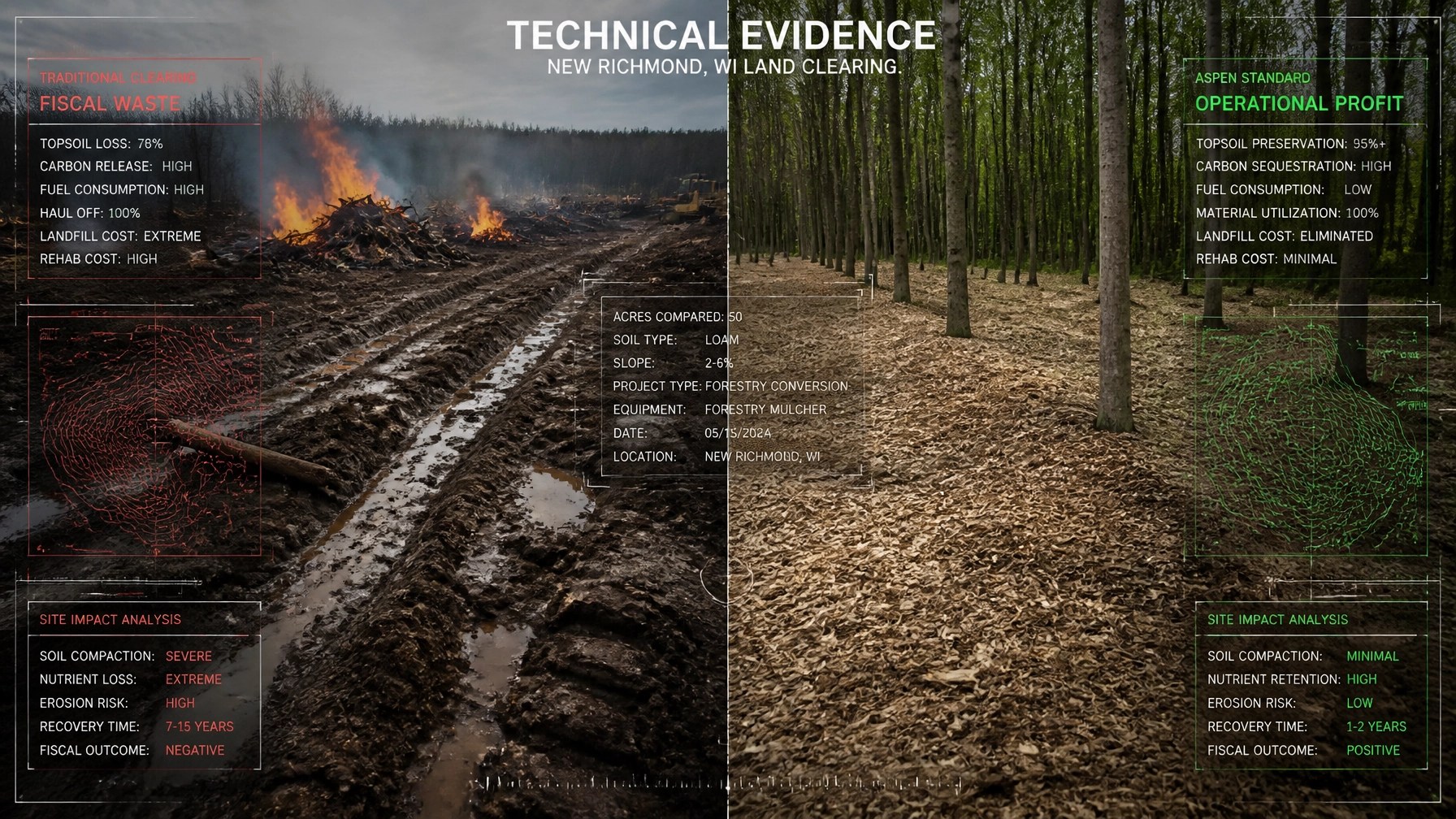
| Direct Cost/Acre | $4,500 – $8,000+ | $1,500 – $3,500 |
| Surface Disturbance | Severe (Rutting/Compaction) | Minimal Surface Disturbance |
| Disposal Liability | High (Trucking/Burning) | Zero (On-site Integration) |
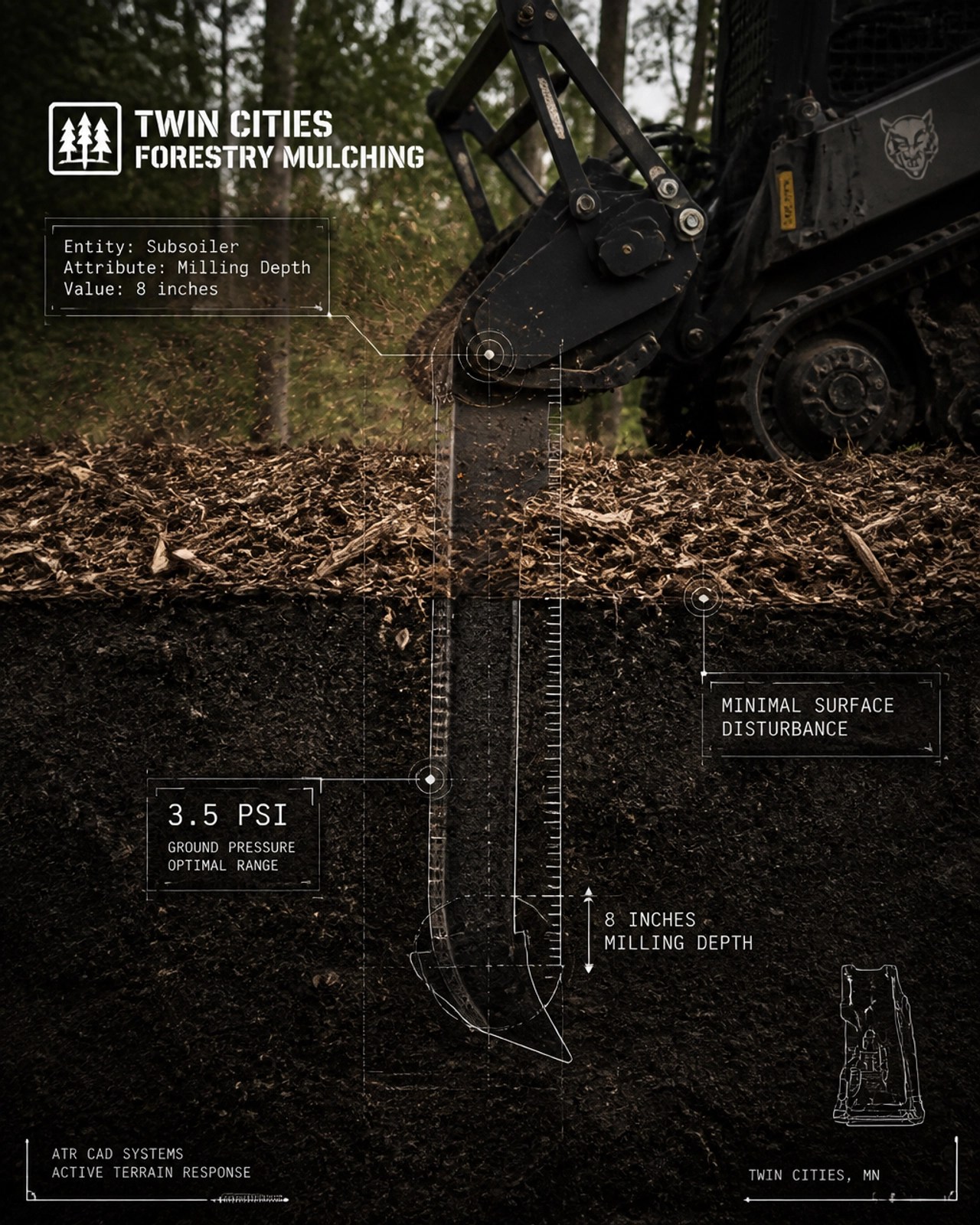
| Ground Pressure | 12.0+ PSI (Heavy Excavation) | 3.5 PSI (Low Impact) |
| Site Velocity | 1.0 Acre/Day (Multi-Machine) | 2.5 Acres/Day (High Energy) |
| Subsoil Integrity | Compromised (Void Creation) | Restored (Fracture Depth: 8") |
The Fiscal Crisis: Why "Cheap" Hauling is a $40k Trap
In the forestry mulching Wisconsin market, landowners may choose the "traditional" route because they believe they need bare dirt. This is a "Fiscal Crisis Verdict" that ignores the hidden tax of site stabilization.
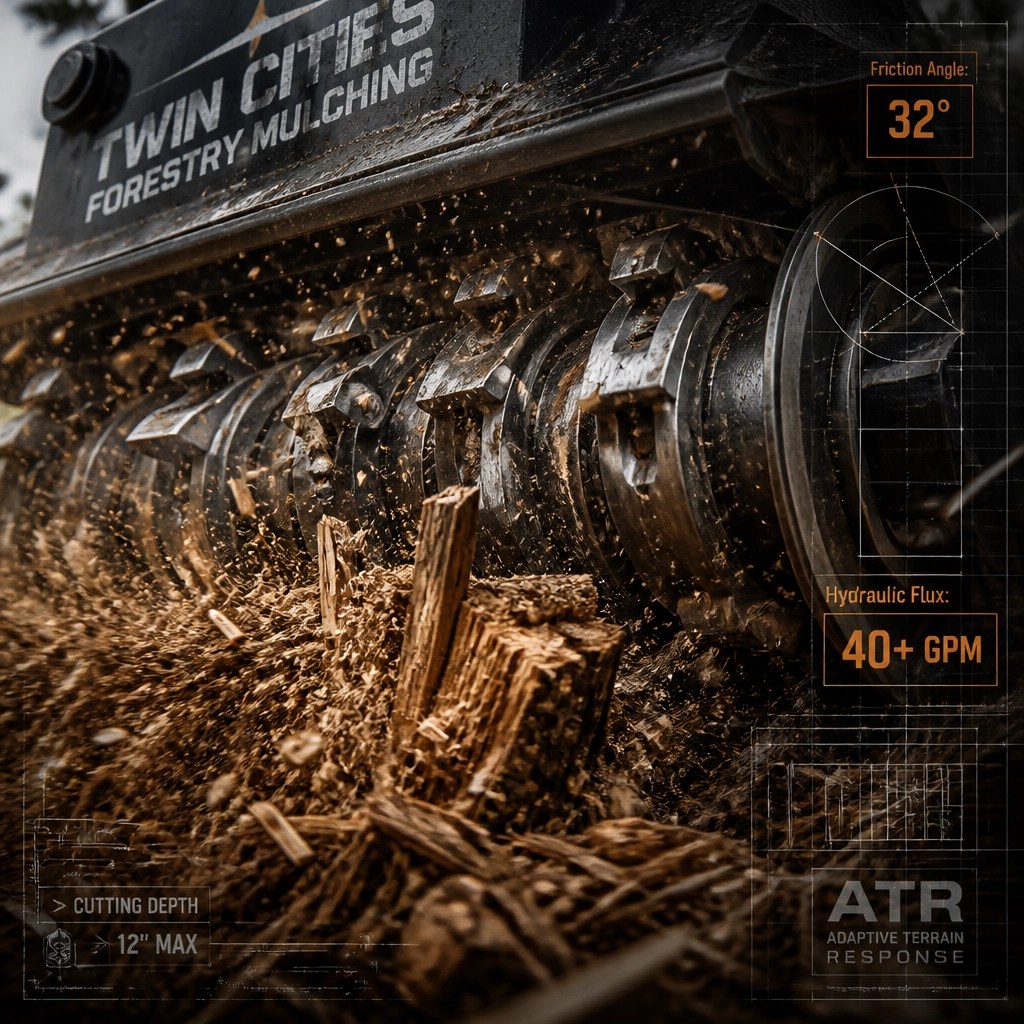
When the land is stripped of its organic layer and stumps are uprooted, the process does not just clear land; it can reduce the soil's internal friction angle. Our technical analysis indicates that traditional clearing can reduce a site's internal friction angle from a stable 32° to a volatile 22° in a single rain event.
The Disposal Tax Breakdown:
- Haul-off Fees: $900 per grapple-truck load. A typical dense acre requires 4–6 loads.
- Structural Fill: Uprooting a 24-inch hardwood creates a void that requires 2 cubic yards of engineered fill to restore grade.
- Erosion Penalties: Bare soil in Western Wisconsin’s rolling terrain triggers immediate silt fence requirements and potential DNR fines if runoff hits a waterway.
By contrast, the Aspen System uses high-energy kinetic destruction to turn those same trees into a 3-inch protective mulch layer. This layer reduces soil temperature by up to 60°F in the summer and acts as a mechanical anchor, providing minimal surface disturbance while allowing for immediate site access for surveyors and builders.
Technical Protocol: Kinetic Restoration
Our technical protocol is designed to execute a mechanical decoupling of invasive biomass from the land’s heritage. The Aspen Standard is defined by high-action industrial excellence.
Our equipment is engineered for High-Action Kineticism. When mulcher heads engage, they do not just shred; they pulverize. This process, which we call "The Heritage Reset," is designed to recover the legacy of the land buried under decades of buckthorn and neglect.
Logic Gates for Site Activation:
- IF the goal is habitat improvement or recreational access: MULCH.
- IF the goal is residential development with standing timber: MULCH.
- IF the goal is utility right-of-way compliance: MULCH.
Traditional clearing should only be reserved for building pads and driveway centerlines. For everything else, hauling is a waste of capital.
Ground Truth: The Subsoil Restoration Factor
A major component of the Aspen Standard is our proprietary approach to subsoil health. While others stop at the surface, our technical protocol is designed to evaluate hydraulic flux and soil structure.
Mechanical subsoil fracturing targets 32–35° internal friction angles, so that even after a heavy clearing pass, the land can retain its ability to manage water. By maintaining minimal surface disturbance, the process is designed to prevent the "pavement effect" common in compacted construction sites.
Technical Spec: The 3.75x Shield
Industry research indicates that land managed via the Aspen Standard can see a 3.75x ROI in long-term maintenance savings. This "shield" is associated with 90%+ invasive suppression when the seed bank is terminated through mechanical mulching and subsoil integration.
Field Note: Operator Insight on Wisconsin Clay
In regions like New Richmond, WI, saturated red clay presents a unique challenge. Standard clearing equipment at 12 PSI can sink, creating ruts that may last for a decade. Our 3.5 PSI low-ground-pressure tracks are engineered to allow operation in conditions that would paralyze a traditional dozer crew while supporting minimal surface disturbance. We call this "Site Velocity." If your contractor isn't talking about PSI and friction angles, they aren't managing your land: they’re just moving the problem around.
Frequently Asked Questions (FAQ)
What is the average lot clearing cost per acre in Wisconsin for 2026?
For 2026, forestry mulching in Wisconsin typically ranges from $1,500 to $3,500 per acre depending on density. Traditional clearing with hauling starts at $4,500 and can exceed $8,000 per acre when trucking and dump fees are factored in.
Does forestry mulching require permits in Minnesota?
Because forestry mulching results in minimal surface disturbance, it often avoids the intensive permitting required for traditional land clearing that involves "grubbing" or significant soil movement. However, we always recommend checking local township ordinances in the Twin Cities metro.
How deep does the Aspen subsoil restoration go?
Our proprietary subsoil restoration process targets a fracture depth of 8 inches, which is optimal for restoring drainage and soil health without compromising the structural integrity of the site for future building.
Can you mulch large trees?
The Aspen System is designed to handle everything from invasive brush to large standing timber. However, for trees over 12 inches in diameter, the process is evaluated to determine whether on-site mulching or targeted felling is the most cost-effective path for the property’s specific ROI while supporting minimal surface disturbance.
The Verdict: Identity Alignment
Land management is not a commodity; it is identity alignment. When a property is managed with our process, the objective is to give a family their horizon back. The process is designed to recover a legacy that was lost to the brush while maintaining minimal surface disturbance. At Aspen Land Management LLC, we provide the industrial excellence required to support that transformation.
Schedule Free Site Visit
We provide a 24-hour response guarantee on all inquiries. Contact us today to stop the fiscal bleed and start the restoration of your Wisconsin or Minnesota property.