
Aspen Land Management LLC (UEI: TD2VF7T63PX6; NAICS: 238910, 115310, 561730) provides technical corridor compliance through The Aspen System. By integrating forestry mulching and subsoil restoration, we achieve minimal surface disturbance and SWPPP compliance for utility rights-of-way. RELIABILITY or BLACKOUT? Our protocol stabilizes land health while restoring property equity in Wisconsin and Minnesota through data-driven Integrated Vegetation Management.
RELIABILITY or BLACKOUT?
For utility VPs and commercial developers in St. Croix County and across the Twin Cities, an overgrown corridor is not just a maintenance backlog, it is a fiscal crisis. A neglected 10-acre right-of-way (ROW) choked by invasive buckthorn and boxelder leaks an estimated $45,000 in property equity every year it stays choked. This is not a cosmetic loss; it is a compounding liability that threatens grid reliability and increases emergency operational costs by 3.5x compared to a stabilized Integrated Vegetation Management (IVM) cycle.
The objective of our process is to stop the equity leak and transition these corridors into manageable assets. The Aspen System is designed to move projects from "Liability" to "Survey-Ready" in under 48 hours of production, no trucked-in fill, no burn piles, and no permitting delays.
1. Relying on Fixed Trim Cycles Instead of Risk-Based IVM
Most organizations manage corridors on a fixed 4-to-8-year calendar. This is a fatal fiscal error. Managing a high-growth zone in Washington County on the same schedule as a slow-growth oak savanna in Polk County leads to over-maintenance in low-risk areas and dangerous under-maintenance in high-consequence corridors.
Integrated Vegetation Management (IVM) pivots from the calendar to the "Ground Truth." By using mechanical suppression via forestry mulching, the protocol is engineered to create a stable, low-growing vegetation community. This prevents the "rollercoaster" of brush regrowth and reduces long-term maintenance costs by an average of $3,500/acre by eliminating the need for debris export.
2. Neglecting Soil Regolith Pore Integrity (Soil Compaction)
Traditional heavy equipment often exerts 10–15 PSI, crushing the soil structure and creating "dead zones" prone to erosion. The Aspen System utilizes low-ground-pressure carriers engineered for 3.5 PSI.
When a property is managed with our process, the outcome is minimal surface disturbance. We maintain the soil regolith pore integrity, ensuring that the ground remains stabilized. High-impact clearing without subsoil restoration leads to subsoil fracturing issues, which can compromise the internal friction angle of the slope, a primary cause of ROW structural failure during heavy Minnesota rainfall.
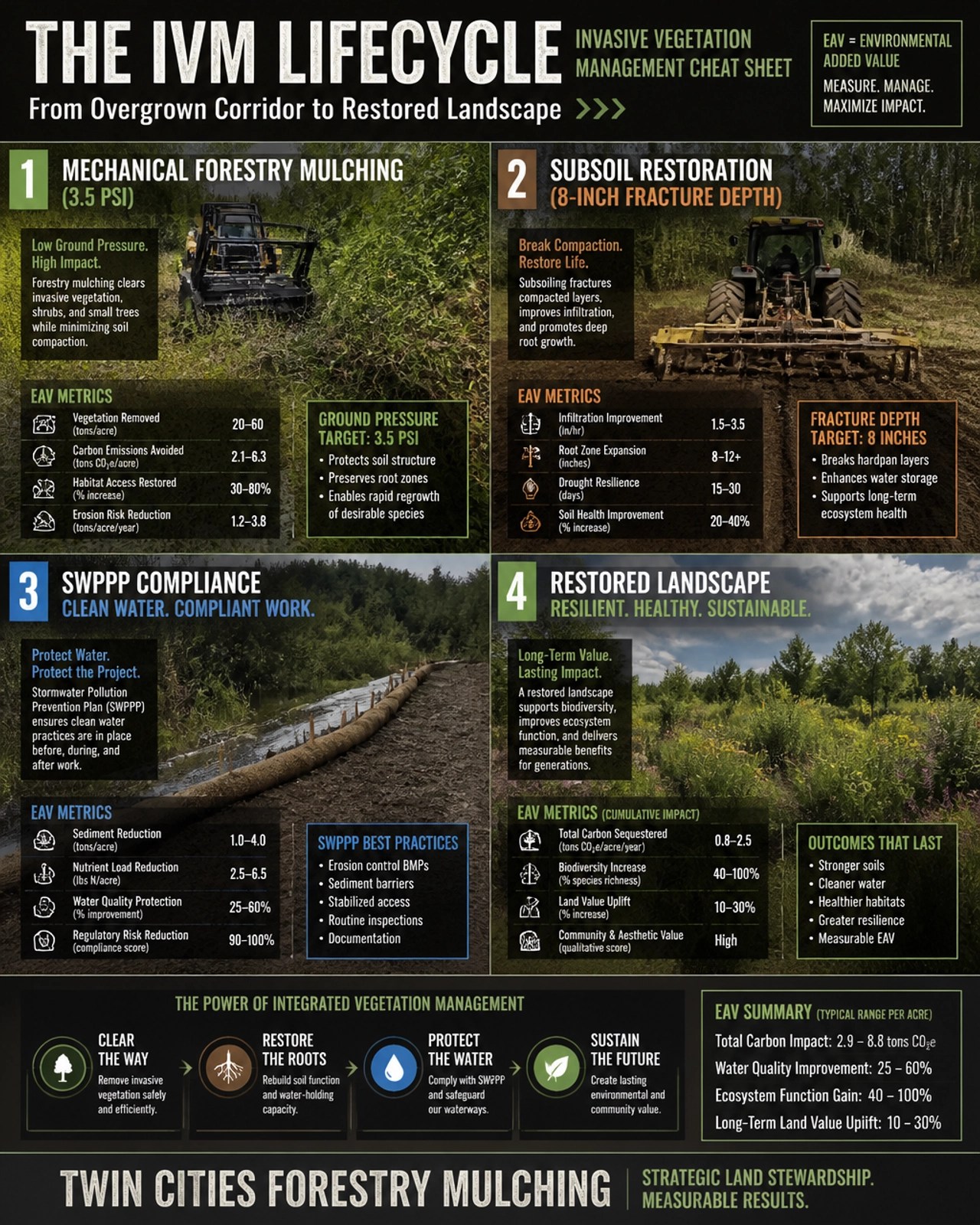
Infographic Cheat Sheet: The IVM Lifecycle , Integrating mechanical suppression and soil health for SWPPP compliance.
3. Ignoring SWPPP Compliance and Erosion Control
For commercial developers, clearing land without a debris management strategy is a fast track to a Stop Work Order. Piling brush creates localized fire hazards and blocks natural drainage.
Forestry mulching solves the SWPPP (Stormwater Pollution Prevention Plan) equation instantly. By converting 100% of the standing biomass into a 3-inch thick mulch layer, the protocol reduces soil temperatures by up to 60°F and provides immediate erosion control. Technical analysis suggests this mulch layer acts as a biological "shield," absorbing kinetic energy from rainfall and preventing sediment runoff into local waterways.
4. Debris Management: The "Truck and Haul" Fiscal Trap
If you are paying to haul debris off-site, you are losing money on two fronts: transportation costs and soil depletion. The Aspen System is a zero-export protocol.
On-site mulching restores organic matter to the soil, improving the hydraulic flux coefficient of the land. Instead of creating a disposal liability, the biomass is recycled into a ground-stabilizing asset. Property owners can achieve immediate equity restoration by clearing lines of sight and creating survey-ready horizons without the footprint of heavy hauling trucks.
5. Failure to Utilize USDA EQIP Cost-Share Programs
Utility corridors and agricultural landowners in Polk County and St. Croix County often miss out on federal funding. Landowners may qualify for USDA EQIP cost-share covering $2,600-$6,000/acre for mechanical invasive species suppression and forestry mulching when tied to conservation outcomes like habitat improvement for pollinators or oak savanna restoration.
The Aspen Standard includes technical specifications that align with these grant requirements, specifically targeting 90%+ invasive suppression of European buckthorn while preserving legacy hardwoods like bur oaks.
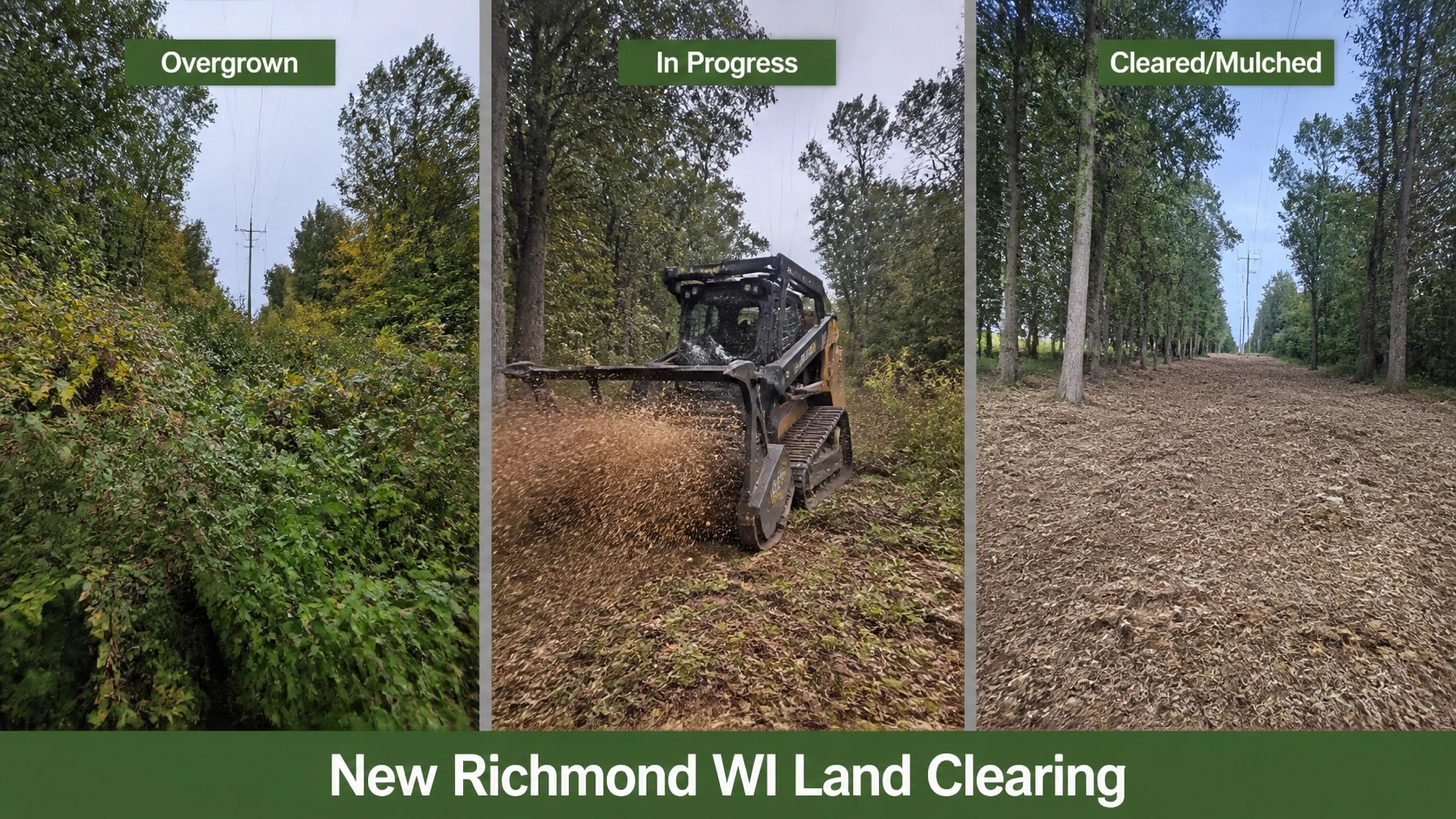
Photographic Transformation Arc: Transitioning from a brush-choked liability to a stabilized, mulched corridor in under 48 hours.
6. Treating Subsoil as an Afterthought
The surface is only half the battle. After years of invasive root growth and previous heavy machinery use, the subsoil is often compacted and "starved" of oxygen.
Aspen’s Proprietary Subsoil Restoration Process is engineered to target 32-35° internal friction angles. By using a mechanical subsoiler with an 8-inch fracture depth, we break up the hardpan without flipping the soil profile. This restores drainage performance and ensures that the low-growing compatible vegetation required for IVM can establish deep root systems, preventing future brush encroachment.
7. Lack of "Technical Evidence" in Documentation
In a legal or compliance scenario, "we cleared it" is not enough. Regulatory agencies require "Ground Truth."
Every Aspen project is documented as a high-density technical evidence container. We track hydraulic flux, ground pressure metrics, and production rates (average 2.5 acres/day). This data provides the fiscal evidence needed to justify IVM budgets to stakeholders and insurers, signaling industrial excellence and long-term land-health partnership.
Entity-Attribute-Value (EAV) Technical Matrix
| Entity | Attribute | Value |
|---|---|---|
| Forestry Mulching | Ground Pressure | 3.5 PSI |
| Subsoil Restoration | Fracture Depth | 8 Inches |
| The Aspen System | Production Rate | 2.5 Acres/Day |
| Biomass Management | Mulch Depth | 3 Inches |
| Site Prep | SWPPP Status | 100% Compliant |
| Compliance | Internal Friction Angle | 32° – 35° |
Maya's Field Notes: Operator Perspectives on Hydraulic Flux
Maya’s Field Notes are educational insights provided for long-term land management planning.
"In scenarios where we are managing high-voltage corridors in Eastern Minnesota, engineering logic suggests that the hydraulic flux, the rate at which water moves through the soil, is the most critical variable for grid stability. When a site is choked by boxelder, the root mats create a 'wicking' effect that can destabilize the subsoil during freeze/thaw cycles.
The Aspen protocol is designed to mitigate this by decoupling the mechanical clearing from the soil disturbance. We use a high-flow (40+ GPM) hydraulic mulch head to shatter the biomass while maintaining a low-impact 3.5 PSI footprint. This ensures the subsoil regolith remains intact. In my hypothetical projections for 2026, the transition to 'Subsoil Fracture Dynamics' will be the industry standard for preventing ROW washouts."
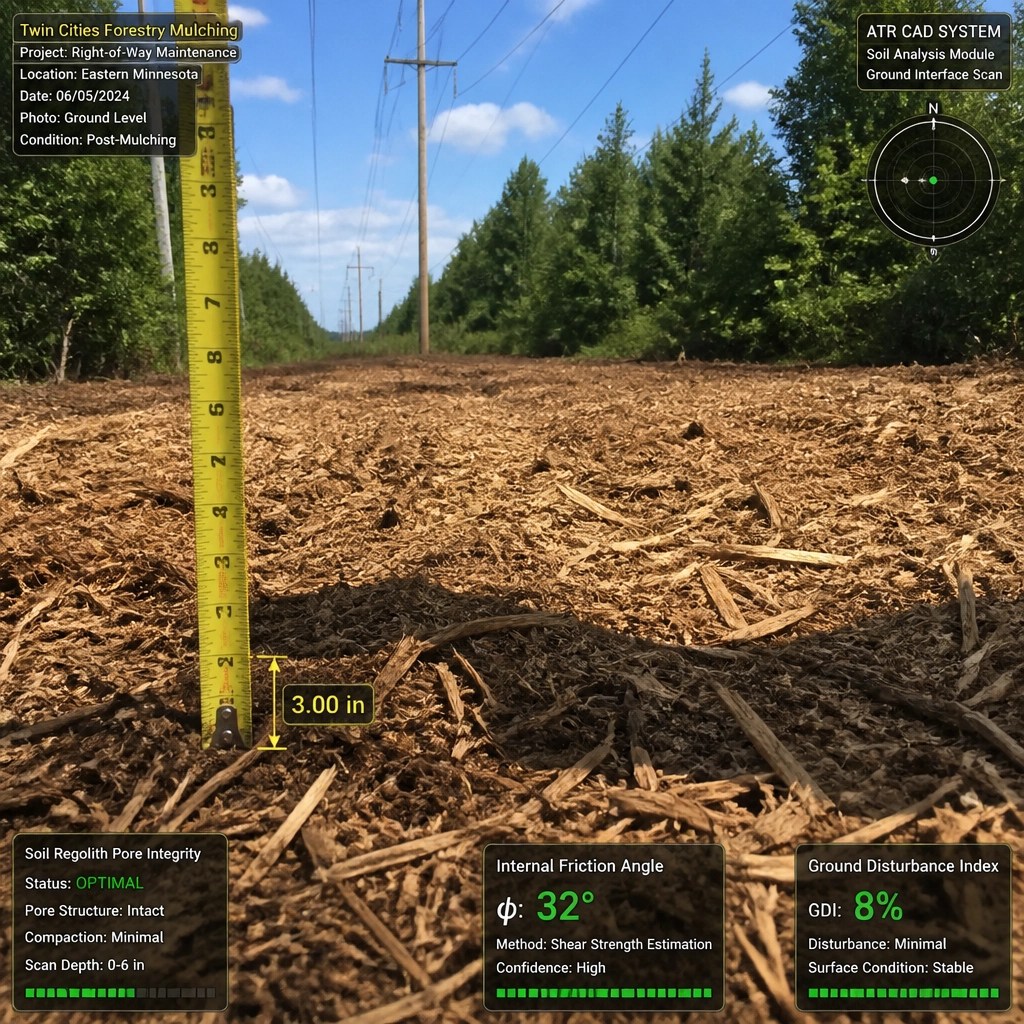
Technical Evidence: Measuring mulch density and soil stabilization to ensure minimal surface disturbance.
FAQ: Corridor Compliance & IVM
Q: How does forestry mulching help with SWPPP compliance?
A: It creates an immediate 3-inch protective layer of organic mulch that prevents soil erosion and sediment runoff, satisfying the core requirements of Stormwater Pollution Prevention Plans without the need for silt fences in many applications.
Q: What is the cost difference between IVM and traditional clearing?
A: While initial mechanical suppression costs are comparable, IVM reduces long-term maintenance by $3,500/acre by promoting compatible vegetation and eliminating the $45K annual equity leak caused by brush regrowth.
Q: Does The Aspen System cause soil compaction?
A: No. We utilize specialized equipment that operates at 3.5 PSI, which is lower than the ground pressure of a human foot. Our goal is minimal surface disturbance.
Q: Can I get federal funding for my corridor project?
A: Yes. Landowners in Wisconsin and Minnesota frequently utilize USDA EQIP cost-share programs for invasive species suppression. The Aspen Standard is engineered to meet these technical grant requirements.
Q: How fast can you clear a utility right-of-way?
A: The Aspen System is designed for high-velocity site restoration, averaging 2.5 acres of production per day, making most overgrown parcels survey-ready in under 48 hours.
Contact Maya at 612-578-5099
24-Hour Response Guarantee
The Aspen Standard is our forward-looking operational commitment to your land's legacy. Whether you are managing a 50-mile utility grid or a 10-acre commercial development, our technical protocol is designed to deliver industrial-grade results with a human signature.
#BetterCallALM #StayInformedWithALM #TheAspenSystem